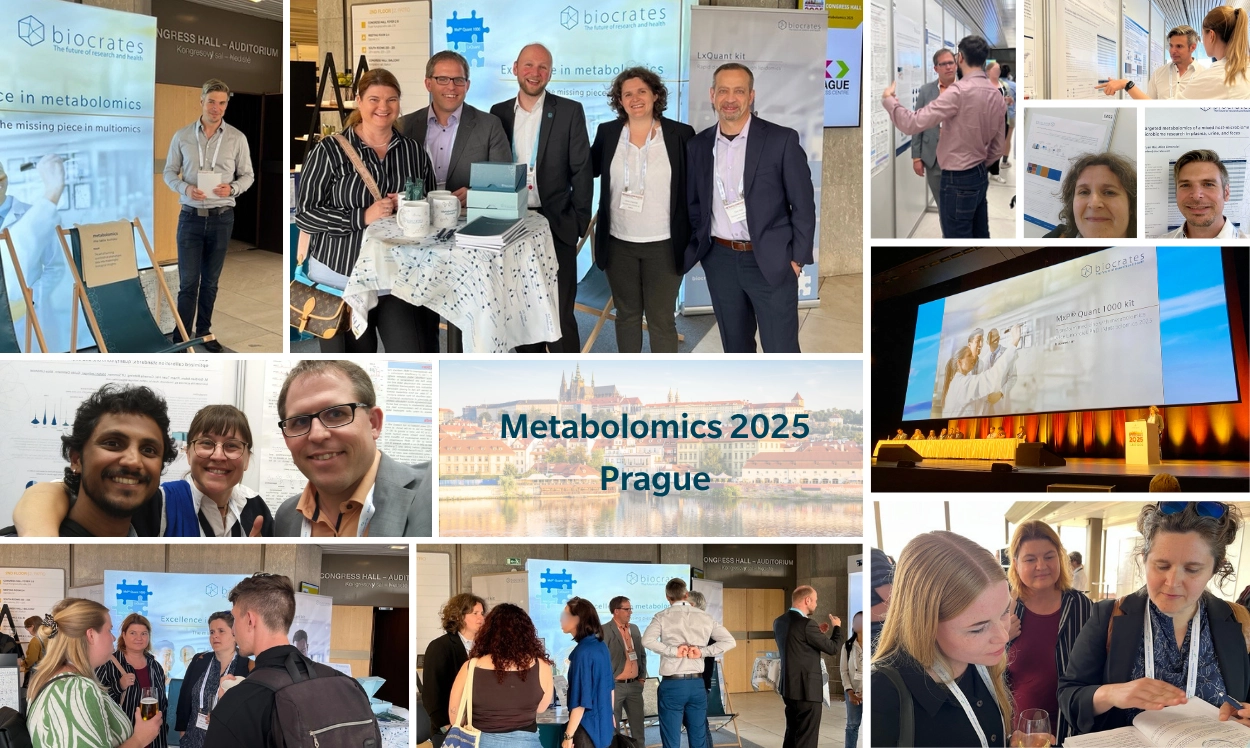
From June 22-26, the metabolomics community gathered at the Prague Conference Center for the Metabolomics Society’s annual conference. The “MetSoc” event is our chance to hear about the latest developments and get a feel for where the field is headed. In honor of our new MxP® Quant 1000 kit – and the 1000-piece puzzle we presented in Prague – I give you my takeaways in 1000 words!
In many ways, the conference came together like a puzzle, with workshops, posters, hallway chats and keynote insights all connecting to reveal a picture of where metabolomics stands today. Rather than a chronological recap, I’ll look at this event through the values we hold dear at biocrates: excellence, purpose, community and ownership.
A picture of excellence
Every year, the Metabolomics Society curates a program at the intersection of chemistry, biology and bioinformatics. From plenary lectures to workshops, the conference doesn’t just focus on human health, but has grown to include microbial metabolism, plant metabolism and increasingly lipidomics, another omic enabled by advances in mass spectrometry.
As I didn’t attend ASMS this year, this was my first opportunity to discuss our new kit face to face with the metabolomics community. The MxP® Quant 1000 kit has our broadest coverage to date, with a coverage of small molecules more than three times our previous flagship product. After the effort we put into developing it, it was so rewarding to see how well our offering aligned with the community’s needs. A great reminder that excellence isn’t just about innovation, it’s also about relevance.
A picture of purpose
Beneath the science, Metabolomics 2025 always feels to me like a call to action. We want to see metabolomics and lipidomics make their way from research labs to clinics. It’s only through the translation of science to practice that we can achieve a healthcare model that’s preventive, predictive, population-based, precision and participatory medicine, AKA “5P medicine”.
This year, I presented a poster on lipidomics measurements from skin microbiopsies and was thrilled to see all the posters of the “at-home sample collection” session. Such solutions are not only great examples of the participatory medicine approach, but they are also essential for the broader democratization of metabolomics.
Data interpretation is another cornerstone of translation. Over the years, I’ve made enormous efforts to make this more accessible, through The Metabolomist podcast, The STORY Principle and various other projects aimed at helping others make sense of metabolomics. I still think effective data interpretation is essential to help us explain the real-world value of metabolomics results and eventually translate them into our daily lives and medical practice.

To mark the launch, we tried something different: sharing the MxP® Quant 1000 kit’s comprehensive metabolic pathway coverage not just as an image, but also as a 1000-piece puzzle! Your reaction was amazing. So many of you competed in our contest to win one of the five puzzles we had at the booth. Thank you to everyone who made suggestions on how to take the concept further. I wouldn’t be surprised if some of your ideas appear in our next set of kit materials.
Speaking of scientific communication, I had the pleasure of hosting the “Scientific Communication” table together with Olya Vvedenskaya at the Early Career Members Network Career Night. This was a great way to start the conference week and mingle with early career scientists or scientists looking for a transition in their career. A fantastic initiative.
A picture of community
From Career Night to the lively breaks, posters sessions and workshops, Metabolomics 2025 did not disappoint when it came to community building. To be honest, I enjoyed the networking so much that I sometimes forgot to attend a session I was interested in.
It was also great to see so many people attend the vendor session where I presented our latest kit in a record five minutes! The sense of camaraderie with other speakers, each of us cramming our key messages into this short time, made it a special experience.
(If you’d like to learn more about the kit, I invite you to register for our live event celebrating the launch of the kit: “Transform medicine with metabolomics”.)
For this MetSoc, I also brought back an old favorite and asked ten attendees to tell me about their favorite metabolites. It’s a fun and simple way to break the ice and get to know people, and always entertaining to hear why you love these metabolites so much. You can listen to the MetSoc episode on The Metabolomist website and all podcast platforms.
A picture of ownership
This year’s Metabolomics conference was also marked by questions about the elephant in the room: the recent acquisition of biocrates by Bruker corporation and its impacts on biocrates’ activities going forward. In short, as manufacturers of metabolomics and lipidomics kits, it is still essential for us to build solutions that enable the use of omics regardless of the analytical platform used.
The exhibition hall where the biocrates booth was surrounded by all major mass spectrometry vendors was an especially great environment to reassure both mass spec vendors and customers that we stay committed to our multi-vendor strategy. If your instrument is already supported by our kits, or if there’s a specific instrument you’d like us to adapt the MxP® Quant 1000 kit to next, we’d love to hear from you.
The final piece in the puzzle
Metabolomics 2025 truly was a conference worth 1000 words. Despite the scale of the conference, it always feels like we are working together to push the field forward. Fittingly, this year’s event attracted around 1000 registrations. A coincidence or a sign? I’ll leave it up to you to decide.
To everyone who visited the booth, asked about the modularity of our new kit, joined a conversation over a cup of tea, or shared their favorite metabolite: thank you and I hope to see you next year in Buenos Aires!
Find out more about the MxP® Quant 1000 kit.